
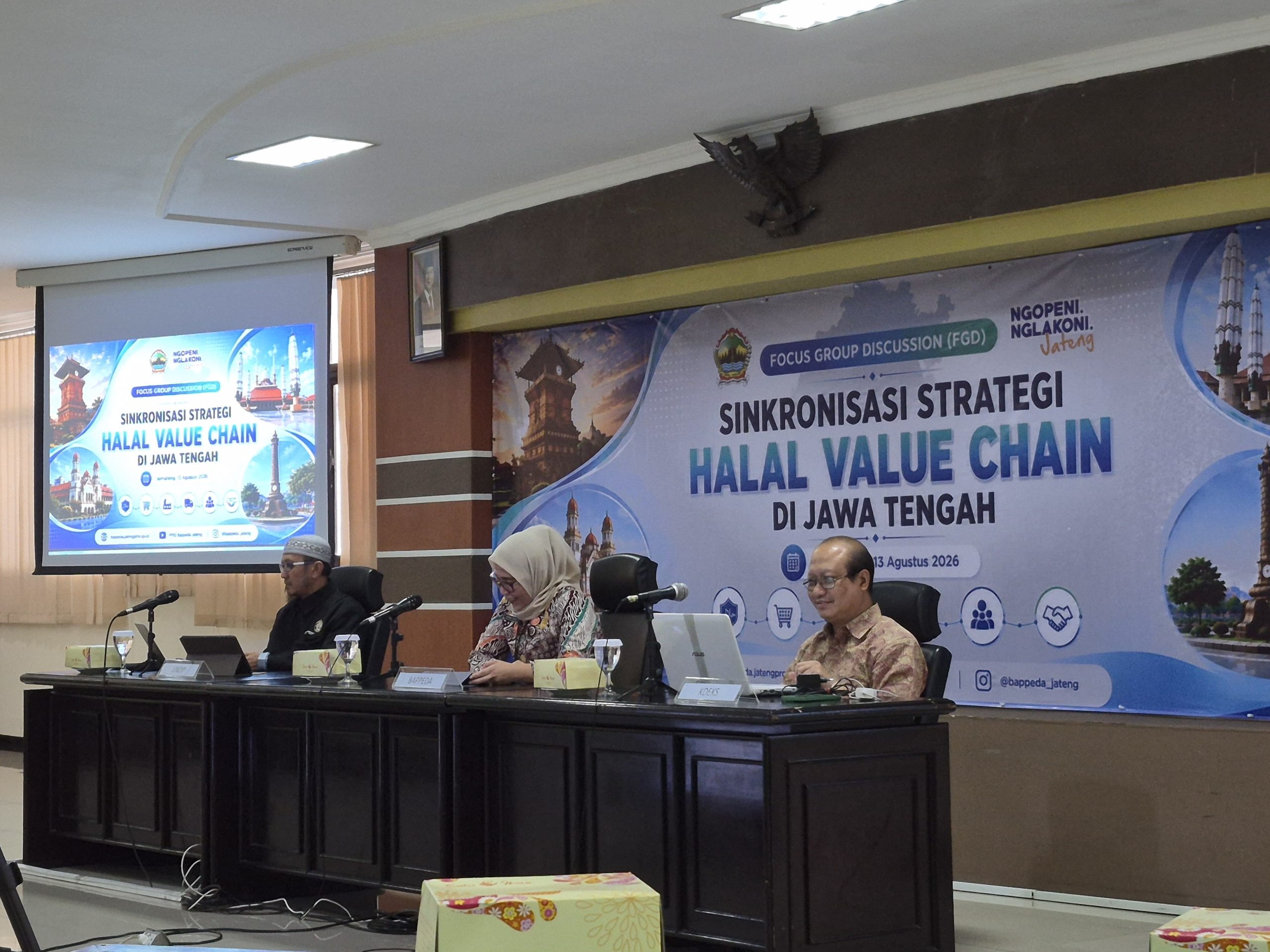
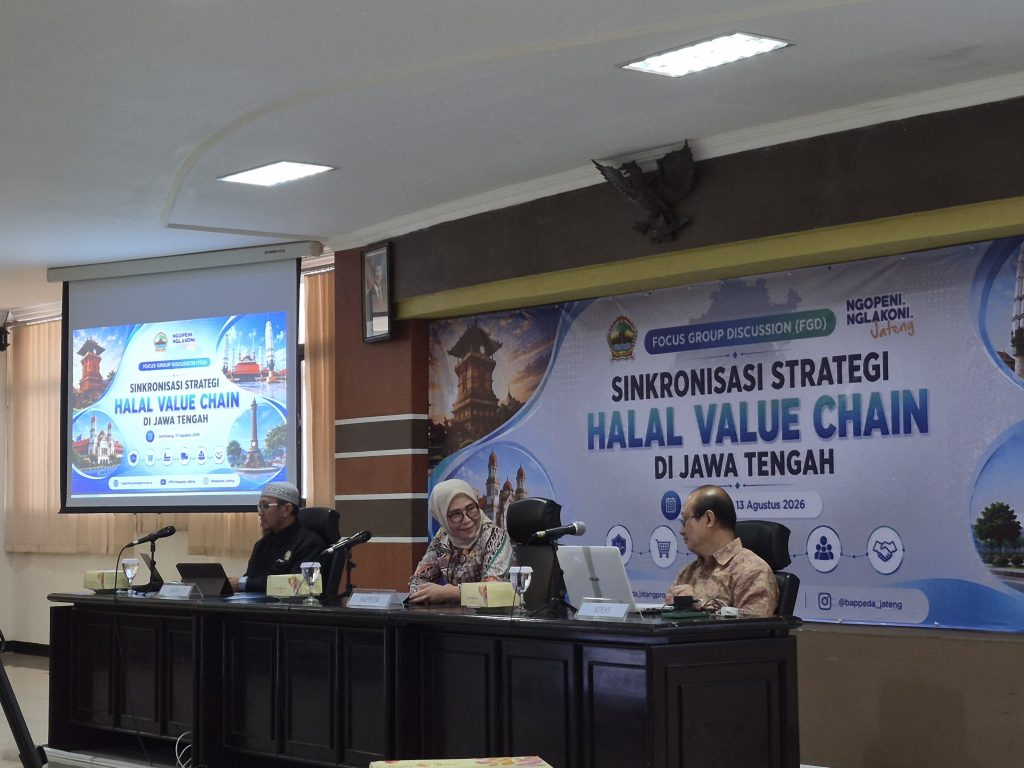
Semarang, August 13, 2026 – Strengthening the halal industry ecosystem is one of the strategic agendas in encouraging the increase in added value and competitiveness of the Central Java economy. This became the focus in the Focus Group Discussion (FGD) “Halal Value Chain Strategy Synchronization in Central Java” held by the Regional Development Planning Agency (Bappeda) of Central Java Province on Thursday (8/13/2026) at the 5th Floor Meeting Room of the Central Java Provincial Inspectorate, Semarang.
The activity is part of the effort to harmonize the halal value chain development strategy with the direction of Central Java’s economic development. FGD presents Diponegoro University (UNDIP) academics, including Dr. Arif Pujiyono, S.E., M.Si., as a speaker in the session “Recommendation of the Central Java Halal Value Chain Strengthening Strategy”. In the agenda, UNDIP academics discussed the potential, problems, strategic priorities, policy recommendations, and the direction of the implementation of strengthening the Central Java halal value chain for the period of 2027–2030.
In his presentation, Dr. Arif Pujiyono explained that halal value chain is not only related to the certification or halal status of a product, but includes the overall relationship of economic activities, starting from the provision of inputs and raw materials, production process, standardization and certification, financing, distribution, marketing, to consumption while still paying attention to the halal principle.
Central Java is considered to have great potential in the development of halal value chain. This potential is supported by micro, small, and medium-sized business bases (UMKM), processing industry, agricultural and livestock sectors, food and beverages, trade, services, tourism, to Muslim clothing. The diversity of the economic sector in 35 districts/cities in Central Java also opens up opportunities for the development of sector and regional-based halal value chain.
One of the sectors that become an important foundation in the halal ecosystem is food and beverage. Until 2026, as many as 772,013 halal certificates were recorded in Central Java, with micro businesses dominating as many as 755,143 certificates. The data shows the size of the role of micro business actors in the halal industry ecosystem as well as the importance of strengthening their capacity to be able to move up the class and expand market access.
The results of the study of strengthening the halal value chain in Central Java show that the development of the halal ecosystem faces various interrelated problems. These issues include cross-sector regulation and coordination, data integration, halal literacy and competence, business assistance, sharia financing access, service integration, market access, upstream sector readiness, traceability of raw materials, and halal supply chain infrastructure.
Based on the analysis of the Analytic Network Process (ANP), there are four main aspects that are of concern in strengthening the halal value chain, namely government, human resources, services, and infrastructure. From the four aspects, the government is the most dominant factor. Therefore, strengthening regulation, institutional coordination, data integration, and service simplification become an important part in building a more integrated halal ecosystem.
In addition to strengthening the government’s role, the development strategy is also directed to increasing the literacy and capacity of business actors, service integration through digital-based One-Stop Halal Service, expanding sharia financing access, and strengthening halal traceability from the upstream to downstream sectors. This step is necessary so that MSMEs are not only able to meet halal standards, but also have the capacity to increase productivity, product quality, and competitiveness.
Strengthening halal value chain also needs to be done collaboratively by involving the government, academics, the business world, sharia financial institutions, and other stakeholders. This is in line with FGD’s goal to build common perceptions, obtain input on strategic recommendations, harmonize policies, and strengthen synergy in the implementation of the development of the Central Java halal value chain.
In the forum, the discussion of strengthening the halal ecosystem is also associated with the implementation of the Indonesian Sharia Economy and Finance Masterplan (MEKSI) Year 2025–2029. In addition to UNDIP academics, the activities also involve various stakeholders from local government elements, Bank Indonesia, Financial Services Authority, BPJPH, sharia banking, BAZNAS, BMT/KSPPS associations, universities, and related regional agencies.
Through this FGD, cross-sector synergy is expected to be able to produce implementative strategies and recommendations to strengthen the connectivity of the halal value chain from upstream to downstream. The strengthening is not only directed towards the fulfillment of the halal aspects of the product, but also to increasing the added value, productivity, market access, and competitiveness of business actors in Central Java.
The results of the next FGD discussion are expected to be the material for the improvement of strategy recommendations and follow-up on the development of halal value chain that is in line with the direction of the development of Central Java in 2027 and can be integrated into the regional development planning for the year 2027–2030. With strong collaboration between stakeholders, the development of the halal industry ecosystem in Central Java is expected to take place in a more directed, integrated, and sustainable manner.