
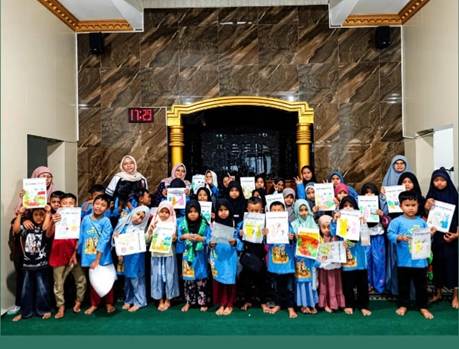
Boyolali, July 21, 2026 — Introducing Islamic financial literacy to children does not have to be done through rigid learning. Farisa Awanis Sholehah The Islamic Economics Study Program Class of 2023 as a student of KKN-T IDBU 15 Diponegoro University then presented a more creative approach through educational activities with students of TPA Ahmad Dahlan, Banyudono Village, Boyolali Regency. This activity combines interactive coloring books and storytelling as an educational medium that is close to the world of children, through collaboration with other cross-faculty students.
The series of activities will then be carried out on July 17, 2026 through the development and use of interactive coloring books as a supporting medium for Islamic financial literacy education. The book is designed with illustrations and coloring activities that are tailored to the characteristics of children, so that the message about financial management habits can be conveyed in a simple, interesting, and fun way.
In the development of this media, Nadila Dwi Eprilia, a student of the 2023 Information and Public Relations Study Program, played a role in designing educational communication media through the development of visual concepts of books. His role includes drafting, developing most of the illustrations, structuring the layout, selecting typography and visual elements, to the editing and finalizing of the design. The design is carried out by considering the characteristics of children as targets so that the message of Islamic financial literacy can be conveyed visually, attractively, and easily understandable.
Meanwhile, Litaussi’il Arzaq, a student of the 2023 Business Administration Study Program, also contributed to the book development process by providing input related to the material, helping to determine the content on several pages, and being involved in making illustrations. The collaboration is carried out through discussion and adjustment between the material and visual concepts so that the resulting books remain informative and interesting for children.
The series of education then continued on July 21, 2026 through the storytelling method by raising the story of “The Hema Rabbit and the Magic Gold Coin”. The story that has been compiled was then conveyed by Farisa Awanis Sholehah, a student of the 2023 Islamic Economics Study Program. Through the story of the Hema Rabbit, the students were invited to get to know simple habits in managing finances, starting from distinguishing needs and desires, saving, living frugally, giving alms, to using money wisely in accordance with Islamic values.
In the implementation of storytelling, books and visual media that have been developed are used to help students recognize the characters and understand various events in the story. Children not only listen to stories, but are also invited to observe illustrations, answer simple questions, and express opinions about the actions of the characters. The use of visual media makes the delivery of material more interactive and helps students follow the storyline more easily.
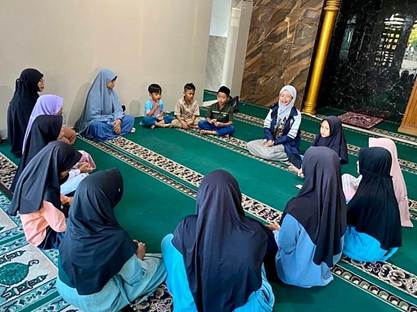
The enthusiasm of the students was seen throughout the activity. They follow the story attentively, actively answer questions, and show interest in the books and illustrations used. The activity was then closed with a short quiz to find out the participants’ understanding as well as give appreciation to students who were active during the learning process.
The development of visual media in this activity is one of the efforts to bridge Islamic financial literacy material with the characteristics of children. Through illustrations, color, page layout, and coloring activities, materials that are quite abstract can be packaged into a simpler, more receptive message. The media is also expected to be reused by landfill manager Ahmad Dahlan as a learning support material.
Collaboration between students from the Islamic Economics, Information and Public Relations, and Business Administration Study Programs shows that the delivery of educational messages requires a combination of the right materials, interesting communication media, and an approach that is in line with the goals. Islamic economic values are conveyed through stories, while the message is reinforced through visual media designed to help children understand the material in a fun way.
Through a combination of coloring books, storytelling, questions and answers, and quizzes, this activity is expected to foster understanding and good habits in managing finances from an early age. The students are expected to be able to start distinguishing their needs and desires, get used to saving, sharing with others, and using money wisely and not excessively in their daily lives.
Author:
1. Farisa Awanis Sholehah – 12020223120010 – Islamic Economics – 2023
2. Nadila Dwi Eprilia — 40020623620043 — Information and Public Relations 2023
3. Litaussi’il Arzaq — 14030123120012 — Business Administration 2023
Students of KKN-T IDBU 15 Diponegoro University 2026
Location: Ahmad Dahlan Mosque, Banyudono Village, Boyolali Regency